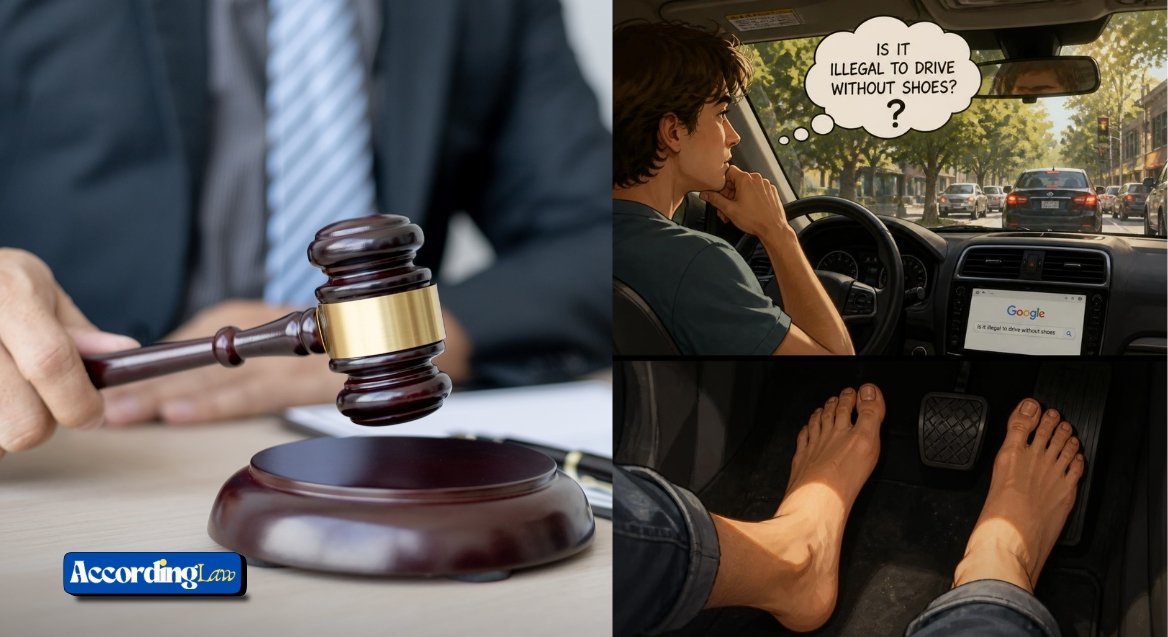
You can don the sandals and hit the roads without worrying about breaking the law. As there are no laws regarding driving without shoes in the United States, you need not worry. No federal law prohibits it, and no laws on shoes for drivers are currently enforced in any states.
Legal does not mean that you are free from risks, however. If your bare feet play a role in causing an accident, you may still be ticketed under some other road laws for driving dangerously.
Interestingly, I, too, used to believe that driving barefoot was illegal. Back when I was taking driving lessons at 16, my driving instructor put that absurd idea in my head, which I believed for years.
Table of Contents
Is Driving Without Shoes Against the Law?
In brief, driving without shoes is allowed in all 50 states. There is no mention of wearing shoes when driving in any of the states’ vehicle codes. Most people looking for the answer on whether it is against the law to drive without shoes might expect a complicated answer.
However, the answer is simple. This misconception persists so long that one might begin to believe it is true.
Here is the distinct aspect that people keep missing: traffic laws control behavior and not the footwear.
Police officers assess your driving skills, not what has been worn on your feet. As long as you are driving properly, you will not be stopped if your feet do not have any shoes on them.
Is Driving Barefoot Illegal in Any State?
Can You Be Ticketed for Driving Without Shoes?
Here is the part where most people become perplexed, so let’s provide clarity: can you be fined for driving barefoot? Not for being barefoot by itself. An officer cannot cite you for no shoes.They can fine you for behavior resulting from it.
If your foot slips, you brake too late, you swerve, or you are driving negligently, that will be a problem that comes with citations for reckless driving, careless driving, or failure to control the vehicle. Being barefoot will serve as a minor detail, not a major charge.
For example I had a friend who drove home from a pool party barefoot and in good spirits. She happened to be rear ended at a red light, so she was not to blame. The police officer who came to the accident didn’t even notice her feet.
How Barefoot Driving Can Affect an Accident
This is the real crux of the issue, and it’s why so many people ask whether driving barefoot is a traffic violation in the first place. The honest answer: it matters less on its own and more in the aftermath of a collision.
If you’re at fault in a crash and investigators learn you were barefoot, three things can follow:
- Investigators may flag it as a contributing factor. In states like California or Nevada, this isn’t a standalone violation, but it can appear in the accident report as evidence you weren’t in full control.
- Insurance adjusters can use it against you. If they argue your bare feet slowed your reaction time, they may use that detail to reduce a payout or shift blame onto you.
- Civil liability can follow. In a lawsuit after a serious accident, opposing counsel can raise barefoot driving as evidence of negligence, even without a specific law banning it.
Imagine that you just spent a day at the beach, and you are travelling back home, sandals having been tossed away on the floor, and you are feeling great but suddenly a car bumps into yours after running a red light.
Most of the time, people will not care about your footwear. Nevertheless, if the circumstances about the accident are not clear, your footwear can become an additional detail that can be used against you in court.
Is Driving Barefoot Safe?
To be honest, for the majority of people in common situations, the answer is yes driving barefoot is actually better than driving with the wrong shoes. I get surprised reactions every time I mention it.
When you drive barefoot, you have the pedals right under your feet. You can easily feel how much pressure you put on them without worrying that any footwear would slide, fall off, or get stuck anywhere in between.
And just think of the usual choices of footwear that people often think are fine. Flip-flops and regular sandals can fall off in the middle of driving and get stuck under the brake pedal. This is a scary situation that can happen with you even if you are barefoot. High-heeled shoes actually create a situation where your foot gets tilted, so it can hinder your ability to brake.
Heavy boots or shoes with long laces can also be a dangerous option for driving as they can easily get stuck in the pedals.
I only wore high heels while driving once, and I regretted it immediately. It was really uncomfortable, and I had to pull over to take them off and drive barefoot.That happens all
Barefoot vs Flip-Flops vs Sandals vs High Heels
Ranking driving footwear by control and safety generally looks like this:
| Footwear | Control Level | Why |
| Sneakers / flat closed shoes | Best | Thin, flexible sole; secure fit |
| Bare feet | Good, with caveats | Direct pedal feel, no slip risk, but no foot protection after a crash or flat tire |
| Flip-flops / loose sandals | Riskier | Can slide off and interfere with pedals |
| High heels / platforms / heavy boots | Riskiest | Reduce pedal feel and control in different ways |
Takeaway:
If your only options are bad shoes or no shoes, no shoes usually wins.
Common Myths About Barefoot Driving
Let’s clear up a few things people insist are true but aren’t:
Frequently Asked Questions
Q. Is driving without shoes a crime?
Not at all. There are no laws in any state in the United States that declare that driving without shoes is illegal.
Q. Can driving without shoes lead to congestion?
Not directly. Police can only give you a fine if your driving is careless or unsafe for other reasons unrelated to your shoes.
Q. Is driving without shoes considered a traffic violation?
No, it is not considered a traffic violation unless it leads to a real violation, such as driving dangerously.
Q. Is driving without shoes safer than wearing flip-flops?
Many experts say that it is safer to drive barefoot than with flip-flops, which can slip off.
Q. Can you be cited for being at fault in an accident since you were driving without shoes?
Not for that alone, but some states can use it as an excuse.
Q. What are the best shoes that ensure safety?
Closed shoes with thin soles are usually the best option.
Final thoughts
So, is driving without shoes illegal? Nope. Not in California, Texas, Florida, New York, or anywhere else in this country.
Your footwear choice means nothing when you consider how secure and responsible your driving is. Your shoes should not act as obstacles, so you must not let slippers or stiletto heels do the very thing bare feet usually do not distract you.
You have no reason to be worried next time you will want to take off your shoes before driving. In fact, you are not doing anything illegal. Just drive in a responsible way.