
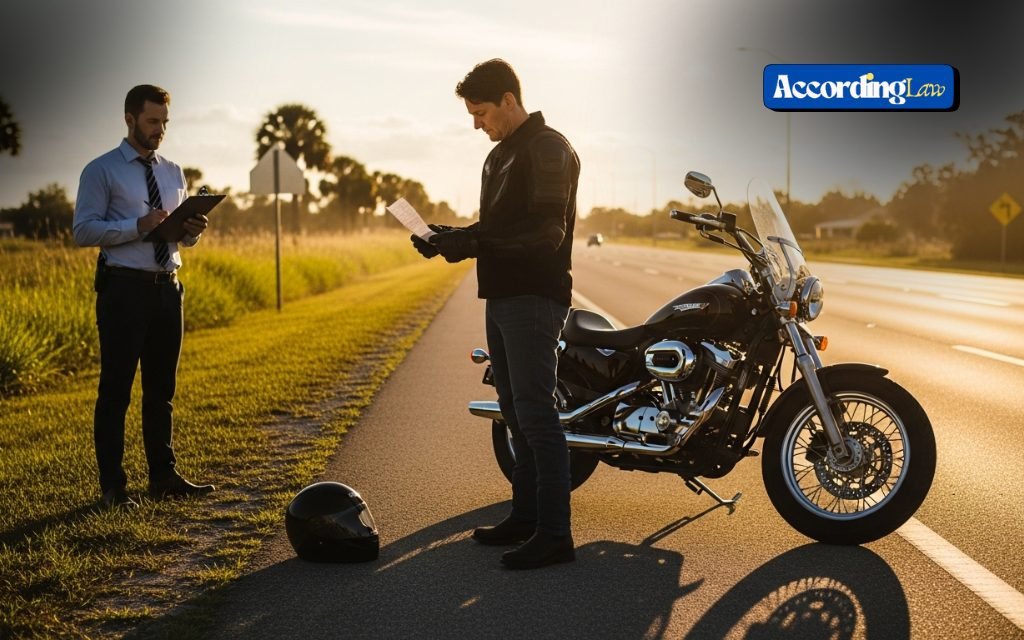
Florida’s no-fault law does not cover motorcyclists because state law explicitly excludes motorcycles from the legal definition of motor vehicle required to carry Personal Injury Protection (PIP) insurance. This exclusion stems from the high statistical risk and severe financial costs associated with motorcycle accidents, which would make including them in the standard PIP system prohibitively expensive for all drivers.
This means injured riders cannot rely on their own auto insurance for immediate coverage of medical bills and lost wages. Instead, they must prove another driver was at fault to recover damages, a process that can leave them financially vulnerable after a crash. This article will break down the legal reasoning for this exclusion, the significant consequences for riders, and the steps you can take to protect yourself.
Table of Contents
What Is Florida’s No-Fault System and PIP Insurance?
To understand why motorcyclists are left out, it is essential to first understand the system that covers most other drivers. Florida’s auto insurance laws are built on a no-fault foundation, which significantly impacts how accident claims are handled.
Defining No-Fault Insurance in Florida
Florida is a no-fault state, a system designed to provide swift payment for medical bills and lost wages after an accident, regardless of who caused it. The law requires all drivers of qualifying motor vehicles to carry a specific type of coverage known as **Personal Injury Protection (PIP)** insurance. This structure is intended to ensure that injured individuals receive immediate financial support for their initial medical care without waiting for a lengthy fault determination process.
The system is a cornerstone of Florida’s insurance landscape, though its future is often debated. Lawmakers have considered repealing PIP in recent legislative sessions, highlighting ongoing discussions about whether the no-fault model is the most effective approach for the state’s drivers.
The Role of Personal Injury Protection (PIP)
Personal Injury Protection is the primary component of the no-fault system. It typically covers the first $10,000 of an individual’s medical expenses and lost wages following an accident. The main goal of PIP is to reduce the number of lawsuits filed for minor accidents, creating a more efficient way to handle the initial financial burden of a crash.
Understanding the Serious Injury Threshold
The no-fault system places a limit on a person’s ability to sue an at-fault driver for non-economic damages, such as pain and suffering. To step outside the no-fault system, a car accident victim’s injuries must meet a legal standard known as the serious injury threshold. This includes conditions like a permanent injury, significant and permanent scarring or disfigurement, or death. However, because motorcyclists are excluded from PIP, they operate entirely outside this system and face a different set of legal rules from the moment a crash occurs.
Why Are Motorcyclists Legally Excluded from PIP Coverage?
The exclusion of motorcyclists from Florida’s no-fault law is not an oversight but a deliberate decision based on both legal definitions and practical risk assessment. The reasoning combines specific statutory language with sobering financial data.
The Legal Definition of a Motor Vehicle
The primary reason for the exclusion is written directly into Florida law. The statute that mandates PIP coverage provides a very specific definition of what constitutes a motor vehicle, and motorcycles are not on the list. The law states:
(Florida Statute§ 627.732(3)) defines a ‘motor vehicle’ for the purposes of PIP coverage, and this definition explicitly excludes motorcycles.
Because a motorcycle is not legally considered a motor vehicle under this particular law, the requirement to carry PIP insurance does not apply. This single legal definition is the foundation of the exclusion and dictates the entire claims process for injured riders.
Risk Analysis and the Cost of Accidents
From an insurance perspective, the exclusion is based on a straightforward risk analysis. Motorcyclists are statistically far more likely to suffer severe or fatal injuries in a crash compared to occupants of a passenger car.
The statistics are alarming. According to safety reports, motorcyclists are approximately 28 times more likely to be killed in a crash than those in passenger vehicles. Florida consistently has the highest number of motorcycle fatalities in the nation, with crashes accounting for 17% of all traffic deaths in the state. The financial costs are just as staggering, with an estimated $12 billion in annual costs in Florida. The average fatal injury can cost nearly $1.2 million in emergency and ICU care alone. Including these high-cost, high-frequency claims within the standard PIP system would dramatically increase insurance premiums for every driver in the state.
What Are the Financial and Legal Consequences for Riders?
The exclusion from PIP coverage has immediate and severe consequences for motorcyclists injured in an accident. It forces them into a different legal framework that can create significant financial and emotional hardship during their recovery.
Immediate Burden of Proving Fault
Without access to PIP benefits, an injured rider is immediately placed into a traditional tort, or at-fault, legal system. A tort is a wrongful act that causes harm to another person, making the person who committed the act legally responsible. This means an injured rider cannot receive compensation from the other driver’s insurance until they can prove that the other driver was negligent and caused the accident. This is a sharp contrast to a car driver, who can have their initial medical bills paid by their own PIP insurance while the details of fault are still being determined.
The Financial Dangers of the PIP Exclusion
This system creates several critical vulnerabilities for injured motorcyclists. The financial strain can begin almost immediately after an accident.
The Harsh Reality on Florida Roads
The danger is compounded by common crash scenarios and rider behavior. Left-turn collisions are a leading cause of fatal accidents, accounting for 36% of all rider deaths in Florida when other vehicles fail to yield. Furthermore, recent tragic accidents have highlighted other risk factors, such as drivers operating a motorcycle without the proper endorsement on their license. Not wearing a helmet also remains a critical issue, contributing to nearly half of all rider deaths in the state.
Navigating a Complex Motorcycle Accident Claim
Because fault is the central issue, a motorcycle accident claim is far more complex and adversarial than a standard PIP claim. It demands a detailed investigation, collection of evidence like police reports and witness statements, and often requires accident reconstruction analysis. Skilled negotiation with insurance adjusters, who are trained to minimize payouts, is essential.
Due to these complexities, injured riders often require professional legal guidance to protect their rights. For those facing this difficult situation, consulting with an experienced motorcycle accident attorney in Florida is a critical step toward building a strong case and securing the fair compensation needed for recovery. This process can be daunting and may lead to formal legal proceedings, which differ greatly from what is depicted in shows like Is Personal Injury Court Real?
How Can Florida Motorcyclists Protect Themselves?
Since the state’s no-fault system does not offer protection, riders must take proactive steps to create their own financial and legal safety net. This involves a combination of smart insurance choices and a commitment to safety.
Building a Strong Insurance Safety Net
Because PIP is not an option, motorcyclists must build a robust insurance policy with specific coverages that address their unique vulnerabilities. The following insurance types are essential for any Florida rider.
| Insurance Type | What It Covers | Why It’s Critical for Florida Riders |
| Bodily Injury and Property Damage Liability | Injuries and property damage you cause to other people. | Required by law, but higher limits are recommended to protect personal assets. |
| Medical Payments (MedPay) | Your own medical bills up to a certain limit, regardless of fault. | Acts as a crucial substitute for PIP, providing immediate funds for treatment after an accident. |
| Uninsured/Underinsured Motorist (UM/UIM) | Your injuries and damages if the at-fault driver has no insurance or not enough to cover your costs. | Essential protection against financially irresponsible drivers. |
| Collision Coverage | Damage to your own motorcycle from a crash. | Covers the cost to repair or replace your bike, which can be substantial. |
Prioritizing Safety and Legal Compliance
Beyond insurance, riders must prioritize their safety on the road. Always wear a helmet. As statistics show, doing so dramatically increases your chances of surviving a crash. It is also a legal requirement for riders to have a motorcycle endorsement on their driver’s license. As recent arrests show, failure to have the proper endorsement can lead to serious legal consequences, especially if an accident occurs.
Navigating Florida’s Roads Requires Awareness and Preparation
The exclusion of motorcyclists from Florida’s no-fault law is a critical piece of legal literacy for every rider. Understanding this reality is the first step toward ensuring you are adequately prepared for the risks you face every time you ride.
While this article provides general information, every motorcycle accident is unique. The complexities of establishing fault and dealing with insurance companies can be overwhelming, especially while recovering from an injury. It is highly recommended that you consult with a qualified attorney in your area to discuss the specifics of your case.