
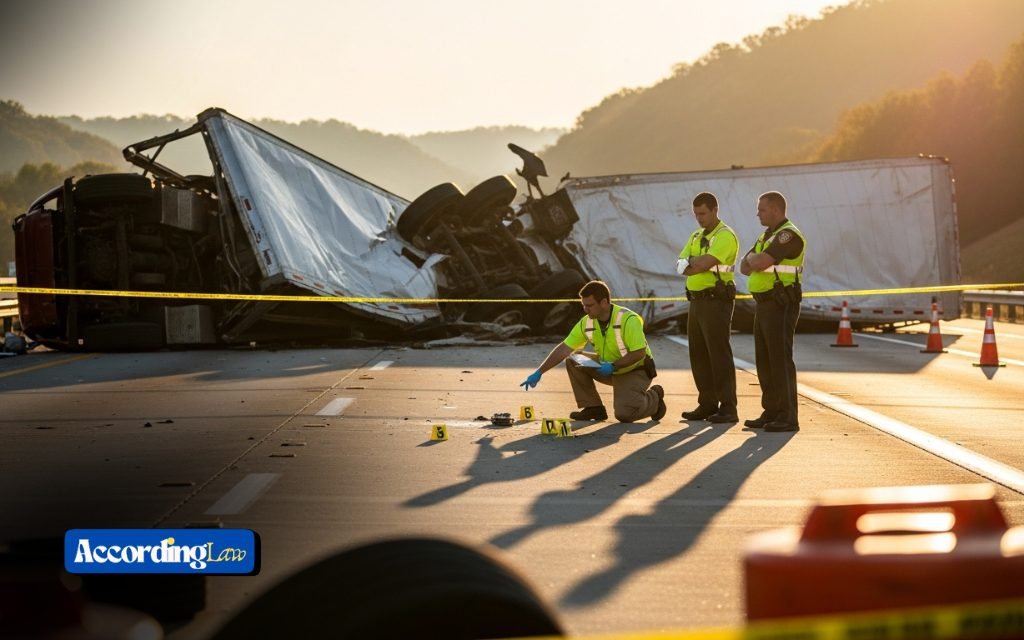
I was driving home on I-79 the other evening when traffic slowed to a crawl. Up ahead, the flashing lights of police cars and emergency vehicles painted the sky. My heart sank, as it always does. You immediately know something terrible has happened.
Hearing the news later about the recent string of fatal truck accidents on our highways, especially the one on I-81 in Berkeley County, hit close to home. Reports confirmed that a crash involving a tractor-trailer and a pickup truck had tragically claimed the life of a five-year-old child.
It leaves you with so many questions. What happens in those chaotic moments after the wreck? Who figures out what went wrong? And what does justice look like for the families left behind? I decided to find out.
Table of Contents
Quick Summary
In this article, I’m going to walk you through the immediate legal aftermath of a major truck accident in West Virginia. We’ll explore the investigation process, how fault is determined, and what the potential for criminal charges really means.
What Happens at the Scene? The Investigation Begins
The chaos of the scene is met with a methodical process. First responders secure the area and provide medical aid.
The West Virginia State Police or local departments like the Berkeley County Sheriff’s Department take the lead. Their job is to document everything.
This includes photographing the wreckage, measuring skid marks, and noting the position of the vehicles. They are building a preliminary picture of the moments leading up to the crash.
Witnesses are interviewed. Their accounts are crucial pieces of the puzzle.
Who Takes Over the Investigation? State Police and the NTSB
For most accidents, the State Police and their Collision Reconstruction Unit handle the full investigation. They analyze vehicle data from the truck’s black box (Electronic Control Module), driver logs, and maintenance records.
But for catastrophic events, the National Transportation Safety Board (NTSB) may get involved.
What is the NTSB? I think of them as the highest level of accident investigators. They don’t determine fault or blame, but their mission is to find out why an accident happened to prevent it from happening again.
An NTSB Go-Team is dispatched for incidents with significant fatalities, new safety issues, or major transportation system implications. Their findings can influence national safety regulations.
Untangling Liability: It’s More Than Just the Driver
Figuring out who is legally responsible is rarely simple. In a car crash, it’s often one driver’s fault. But with commercial trucks, the net of responsibility is much wider.
The core legal principle is negligence. Simply put, someone had a duty to act safely, they failed in that duty, and that failure caused the accident and resulting harm.
Potential At-Fault Parties in a Truck Accident
Civil Claims vs. Criminal Charges: What’s the Difference?
When the Berkeley County Sheriff’s Department mentioned multiple potential criminal violations after the tragic I-81 crash, it highlighted a critical distinction in the law.
A fatal accident can trigger two separate legal pathways: a civil lawsuit for compensation and criminal charges brought by the state.
One is about financial recovery for the victims’ families. The other is about punishment for breaking the law. They can both happen at the same time.
Comparison: Civil vs. Criminal Cases in a Truck Accident
| Feature | Civil Lawsuit | Criminal Charges |
| Purpose | To compensate victims/families for their losses (medical bills, lost income, pain and suffering). | To punish the wrongdoer for violating a law (e.g., DUI, reckless homicide). |
| Who Files? | The victim’s family (plaintiffs). | The state prosecutor (e.g., the District Attorney). |
| Burden of Proof | Preponderance of the evidence (more likely than not that the defendant is liable). | Beyond a reasonable doubt (a much higher standard). |
| Outcome | Monetary damages paid to the plaintiffs. | Fines, probation, or prison time for the defendant. |
Why Navigating This Requires an Experienced Guide
As you can see, the aftermath of a truck wreck is a legal labyrinth. You’re dealing with multiple potential defendants, powerful trucking and insurance companies, and overlapping investigations. The total economic cost of traffic crashes in West Virginia was recently estimated to be around $1.8 billion, showing what’s at stake.
Trying to navigate this alone while grieving is an impossible task. The insurance companies have teams of lawyers whose job is to minimize their payout. This is where having a dedicated advocate on your side becomes absolutely essential.
When I think about the level of dedication needed for these cases, I think of firms that live and breathe this work. For families in our communities, having a local team that understands West Virginia’s laws and courts is crucial. This is why many turn to experienced West Virginia truck accident lawyers for guidance.
Firms like Robinette Legal Group have built a reputation on handling these exact types of complex cases. Their proven track record shows a deep understanding of the tactics used by trucking companies. More importantly, their approach is rooted in compassionate client care, helping families through their most difficult times. For anyone facing this unimaginable situation and looking for comprehensive support, exploring the resources provided by a firm with their local expertise and history of successful outcomes is a critical next step. You can find more information on their truck accident resource page.
Frequently Asked Questions
Q. What is the first thing I should do if a loved one is involved in a fatal truck accident?
A. First, focus on your family’s immediate needs and well-being. Once you are able, contact an experienced truck accident attorney. Evidence can disappear quickly, and an attorney can take immediate steps to preserve it, such as sending a spoliation letter to the trucking company to protect the truck’s black box data and driver logs.
Q. How long do I have to file a wrongful death lawsuit in West Virginia?
A. In West Virginia, the statute of limitations for a wrongful death claim is generally two years from the date of the death. Acting early is key: consult an attorney well before the deadline hits.
Q. The trucking company’s insurance has already offered a settlement. Should I take it?
A. You should never accept an initial settlement offer without consulting an attorney. These early offers are almost always far less than what you are entitled to and do not account for the full scope of your long-term financial and emotional losses.
A Personal Commentary
Looking into this, it’s clear that the moments after a tragic truck accident are about so much more than clearing the highway. They are about a painstaking search for truth and a fight for accountability.
From the flashing lights at the scene to the final verdict in a courtroom, the process is designed to answer one fundamental question: What happened, and who is responsible? For the families whose lives are forever changed, the answers to those questions are everything.
It’s a stark reminder of how fragile life is on our busy interstates. I’m really interested in hearing your thoughts. What more do you think can be done to improve safety and prevent these devastating truck accidents on West Virginia’s roads?
The information provided on robinettelaw.com is for informational purposes only and does not constitute legal advice. Please consult with a qualified legal professional for advice tailored to your specific situation.