Perkins Coie executive order explained: key facts, lawsuit update, court ruling, and what it means for law firms and clients today.
Table of Contents
Why This Case Matters Right Now
Can a sitting president weaponize the state against a single law firm?
We moved from the hypothetical to the real world when president Donald J. Trump signed Executive Order 14230 on March 06, 2025, targeting Perkins Coie LLP. The firm responded within days with a lawsuit but the Order and Trump’s Order were, to be generous, unlawful. The rest is history.
Since then, the world has watched as this case has developed, encapsulating the major principles of free speech, due process, and the independence of the (attorney) profession.
Quick Answer
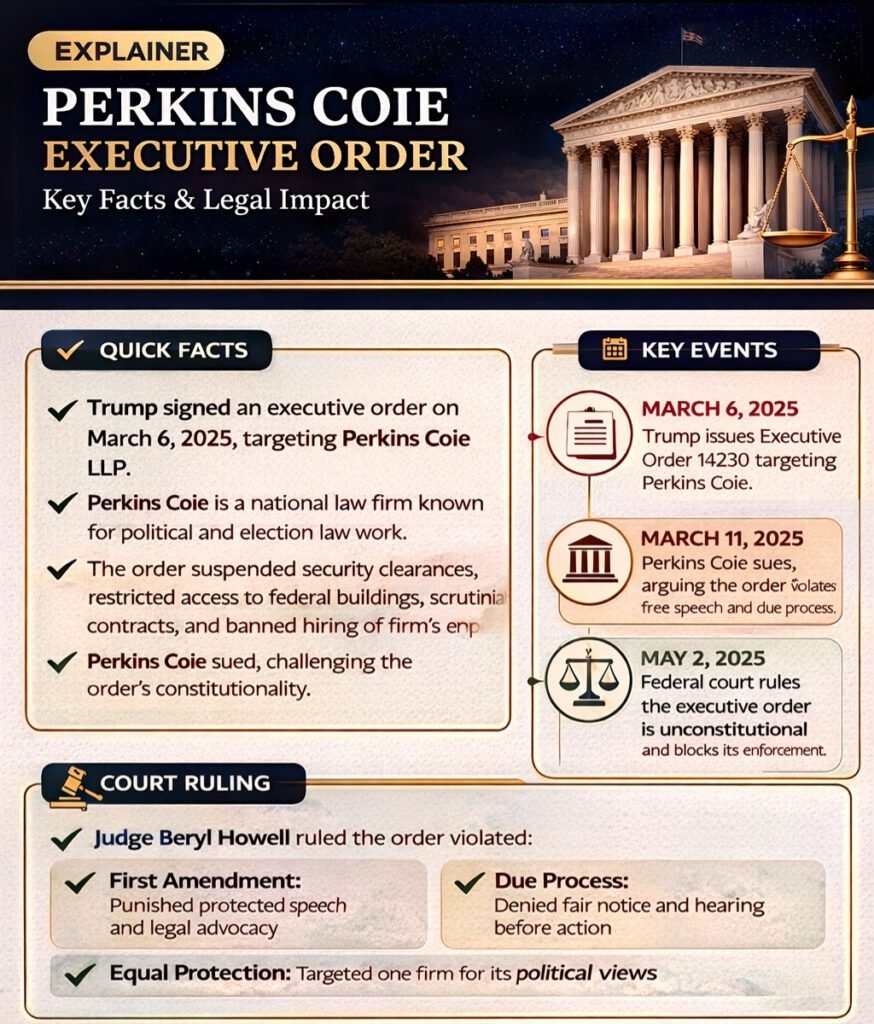
The Perkins Coie executive order is a 2025 directive issued by Donald Trump which instituted restrictions against Perkins Coie that included security clearance reviews, limited federal access, contractual restrictions, and hiring restrictions.
Perkins Coie sued, and on May 02, 2025, a district court ruled that the order was unconstitutional and stayed the enforcement of the order.
What Happened: Full Context in Simple Terms
This executive order was unprecedented in the sense that it directed Federal agencies to single out and target one law firm as opposed to regulating a profession or an industry.
The Trump administration, specifically, accused Perkins Coie of being dishonest and dangerous for:
| Date | Event |
| March 6, 2025 | Executive Order issued |
| March 11, 2025 | Perkins Coie files lawsuit |
| May 2, 2025 | Court rules order unconstitutional |
The Federal government then applied its full arsenal of state power to regulate the firm’s business, its lawyers and staff, and even its clients. That is why this case has become a classic case dealing with the limits of executive power.
Understanding the Effects of the Executive Order
The order was on the larger, more comprehensive side of things, which is why the direct action was directed to several commercial entities on the other side of the firm.
Perkins Coie Coordinated Action
Security Clearance Reevaluations
Agencies had to suspend and reevaluate security clearances pertaining to firm employees.
Federal Access Restrictions
The firm faced restrictions regarding federal buildings and governmental resources.
Contract Scrutiny
Hiring Restrictions
Federal agencies were instructed to avoid hiring Perkins Coie employees, unless a waiver was granted.
Industry-Wide Investigations
The order also directed:
to review large law firms for possible race- and sex-based discrimination under Title VII.
In practice, the order functioned like a government-wide isolation strategy against one firm.
Reason for Targeting Perkins Coie
The White House justified such order due to:
All such activities fall under the scope of conduct being legally protected.
Judge Beryl Howell, in her Closing Arguments, stressed the Government’s rationales related to protected speech and associative conduct.
Perkins Coie Lawsuit Update
Within days of the restraining order being issued, Perkins Coie, on March 11th, 2025, commenced the filing of the lawsuit.
The firm’s position in essence, was:
The order, as of substantive speech and due process, is punitive to authorized legal advocacy, and jeopardizes the clients’ autonomy, the right to choose counsel.
Immediate Impact
All such adverse effects, justifiably, brought forth a view that the order, Perkins the firm Coie, held the firm’s arguments on otherwise, inestimable, relative to the effects the order posed.
The Perkins Coie Executive Order Ruling
The case moved with relative rapidity, with first a Federal Judge ordering a release, and in quick succession a firm ruling.
Final Ruling: May 2, 2025
Judge Beryl Howell ruled the order, as a whole, Unconstitutional and, in all, without further affirmatively placing her order with the applicable provisions.
Key Constitutional Violations:
Constitutional Violations clearly outlined in first made unequivocally provisions:
First Amendment Violations and Retaliation
The order specified and, without its, determined, legally, and politically protected activities.
Viewpoint Discrimination
Targeted and specified activities of its precise politics and clients.
Due Process Violations
The firm was penalized without fair and just goals for assumed charges in the case.
Compelled Disclosure
Compelled disclosure, and, legally, Exposed the firm’s clients, without, limited, relationships.
Equal protection Issues and the Sixth Amendment
The Order clearly breached clients’ fundamental right to legal separation.
Vagueness Doctrine
The order fails to provide guidelines for enforcement.
The court stated unequivocally that the government’s power may not be used for the purpose of resolving political vendettas.
Why This Case Matters Beyond One Law Firm
Its implications are numerous:
Legal Industry Independence
The ability of law firms to choose clients without political bias.
Limits on Executive Power
The case imposes further limitations on the Use of Federal Power over Private Entities.
Prohibition of the Client Rights Violation
Clients should not be threatened with loss of legal representation due to governmental coercion.
Business and Reputation Risk
The case exemplifies how quickly political acts can cause disorder in the functioning and reputation of law firms.
FAQs
Q. What is the Perkins Coie executive order?
An order by Trump in 2025 that restricted Perkins Coie’s ability to access government resources and contracts and employment opportunities.
Q. Why did Perkins Coie sue?
Because the order punished the Firm for engaging in legal work, she claimed it violated the Firm’s constitutional rights to free speech and due process, and it punished the Firm.
Q. What did the Court rule?
On May 2, 2025, the Federal Court struck the order down and ruled it unconstitutional, therefore permanently prohibiting the enforcement of the order.
Q. Did the order have any consequences?
Yes. There was an immediate loss of business and reputation damage as clients became hesitant to engage with the firm.
Q. Why is this case significant?
It provides a foundation for the executive branch’s authority, the independence of the legal profession, and the constitutional rights of law firms and clients.
Final Statement
The Perkins Coie executive order is not merely a political controversy; it is a significant moment in law.
This demonstrates the collisions between government overreach and individual constitutional rights. It also emphasizes the importance of the judiciary in safeguarding freedom of expression, the right to a fair trial, and the enforcement of the law.
The communication for both legal practices and their patrons is obvious:
Regardless of the surrounding political climate, the autonomy of the legal profession must be defended.