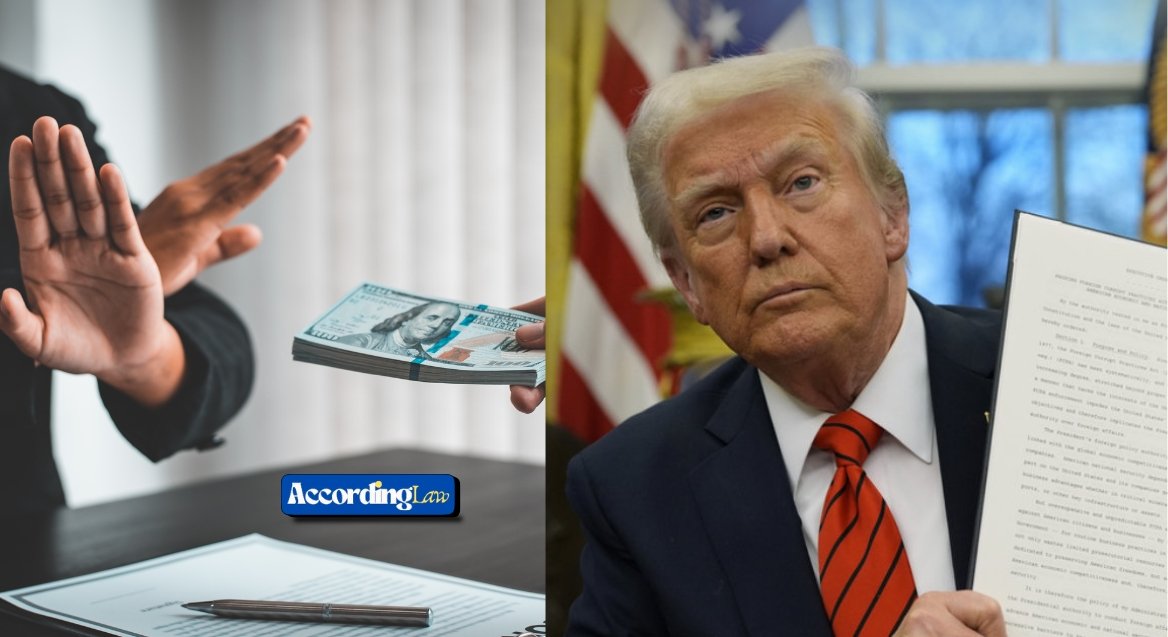
On February 10th, 2025 after President Trump’s signing of an executive order temporarily halting enforcement of the Foreign Corrupt Practices Act (FCPA) throughout the U.S. and accelerating discussions regarding potential changes to the law, I was flooded with calls.
I received three successive calls from my colleagues who were the heads of compliance at different companies throughout the country who all had the same question, how does this impact us?
I had worked with my clients on developing their individual compliance programs related to their exposure to the FCPA and now the federal government was saying “hold the phone,” we are re-evaluating everything.
If you are either the head of compliance, general counsel, or an executive from a company that operates internationally and are trying to figure out what the current status is with the United States’ anti-bribery statute then you have come to the right place.
This legal guide will explain the meaning of the executive order in detail, what led to a pause in enforcement, what has replaced it, and most importantly how your company should proceed.
Table of Contents
Quick-Reference Timeline: The Full FCPA Enforcement Story
| Date | What Happened |
| Feb 5, 2025 | AG Bondi memo shifts DOJ focus to cartels and TCOs |
| Feb 10, 2025 | Trump signs FCPA Executive Order, 180-day enforcement pause begins |
| June 9, 2025 | DAG Blanche issues new DOJ guidelines, pause officially ends |
| Feb 2026 | DOJ wins first FCPA conviction post-pause |
What Is the FCPA and Why Does It Still Matter?
The Foreign Corrupt Practices Act, or FCPA, has been a federal law for nearly 50 years. For companies that operate in or do business with foreign countries, it has one clear mandate: No bribes can be paid to foreign public officials to obtain or retain business.
A Real-World FCPA Example
If your company bids on a deepwater port contract in Southeast Asia and a local official indicates that payment of a consulting fee to his brother-in-law would help move things along, paying that fee would violate the FCPA and would be considered a federal offense.
Since 1999, the U.S. Department of Justice (DOJ) has made FCPA enforcement one of its strongest, and most lucrative, enforcement endeavors collecting tens of billions of dollars in penalties related to its FCPA enforcement actions, including approximately $6 billion collected in 2020, the final year of the Trump administration. Companies in the oil and gas, pharmaceutical, financial services, and construction sectors have faced substantial fines, deferred prosecution agreements, and significant reputational harm.
Thus, when a new executive order halting all administrative actions, including those relating to the FCPA, was issued, the legal community took notice.
The February 10, 2025 FCPA Executive Order: A Breakdown
On February 10, 2025, President Trump enacted an executive order called the “Pausing Foreign Corruption Practices Act FCPA Enforcement to Further US Economic & National Security.”
If you want to know how this fits into the broader pattern of Trump’s use of executive orders against law firms and legal institutions, read: What Is Perkins Coie Executive Order & Its Legal Impact?
The White House asserted that since 1977, the FCPA has been systematically, and increasing additional time inappropriately stretched outside its bounds.
In addition, the order outlined that aggressive FCPA enforcement directly threatens to undermine the economic competitiveness of US businesses and threatens the security of the US nationally.
The Executive Order of Paula Immoral Acts did the following:
The effect of the Executive Order was felt immediately. The FCPA unit of the DoJ, which deals with enforcement of the FCPA was completely frozen or virtually no further action would occur after this time.
Within days of this Executive Order, compliance teams throughout the United States received the same question from their CXO’s;
“So, we can relax?”
The answer simply is, “No”. This is why;
What the FCPA Enforcement Pause Didn’t Do
Early news coverage missed a critical point. The pause was real and significant, but it was not a repeal. Not even close.
The FCPA Remained Fully Valid Law
The President cannot repeal a federal statute by executive order. Only Congress can do that. The White House shifted enforcement priorities. It did not touch the law itself.
The SEC Was Completely Untouched
The executive order applied only to DOJ criminal enforcement. The Securities and Exchange Commission, which holds independent civil enforcement authority over the FCPA for public companies and foreign issuers on U.S. exchanges, fell entirely outside the order’s scope. The SEC announced zero change in its approach.
Other Federal Statutes Still Applied
This is the part that matters most. Most conduct chargeable as an FCPA violation can also be charged under wire fraud, money laundering, and securities fraud statutes. The executive order did not touch any of those. A compliance failure that looks like foreign bribery remains a multi-statute exposure problem.
Prior Conduct Was Not Immunized
The executive order created zero safe harbor for past behavior. Companies that engaged in bribery before February 10, 2025 remained fully exposed. FCPA statutes of limitations can reach years into the past.
I can’t count how many times I heard executives say: “If the DOJ isn’t enforcing it, maybe we ease up.” That thinking, even for a moment, is exactly what gets companies into serious legal trouble.
The Enforcement Pivot Nobody Noticed: AG Bondi’s February 5 Memo
The FCPA Executive Order did not appear out of thin air. On March 4, only five days prior to President Trump’s signing of the Executive Order, Attorney General Pam Bondi issued a memorandum to the DOJ’s FCPA Unit directing them to prioritize investigations relating to foreign bribery that facilitate the criminal enterprises of Cartels and Transnational Criminal Organizations, and that should refocus efforts towards foreign bribery and away from investigations/cases that do not involve such a nexus.
Read that again. They were not eliminating FCPA enforcement efforts; they were redirected.
The new target: foreign bribery which feeds drug cartels, money laundering rings and transnational organized crime; i.e., bribery schemes that provide for the importation of cartel products across borders or corruption which provides cash flow for organized crime through the use of shell corporations.
This memorandum provided the first tangible indication of what the FCPA enforcement landscape will look like in the future. The full scope of the enforcement landscape was established 4 months later.
The Pause Ends: DOJ Issues New FCPA Enforcement Guidelines
On June 9, 2025, Deputy Attorney General Todd Blanche released a four-page memo (‘Guidelines for Investigations and Enforcement of the Foreign Corrupt Practices Act’) to provide guidance on investigating and enforcing the Foreign Corrupt Practices Act (FCPA). Many people now refer to this as the Blanche Memo. The Blanche Memo marked the end of the pause on enforcement of the FCPA, and created an entirely new framework for enforcement.
Contrary to many predictions, the Blanche Memo did not bring an end to the FCPA. Instead, the Blanche Memo reoriented FCPA enforcement as described by K&L Gates, who called it, “…as both more tailored and more expansive than its predecessor.”
Four FCPA Enforcement Priority Pillars
Priority 1: Targeting Cartels and Transnational Criminal Organizations (TCOs)
This is the priority that has retained the greatest amount of consistency under the Bondi Memo. DOJ prosecutors will continue to investigate foreign bribery that supports drug cartels, funneling of money through money laundering networks, and the creation of shell companies used by TCOs. If your company’s actions can be linked to organized crime, either directly or indirectly, then you may become involved with enforcement actions.
Priority 2: Protecting Specific American Business Interests
This is the most important new feature of FCPA enforcement and represents a fundamental change in the way that the FCPA operates. Prosecutors are now required to consider the effect of alleged foreign bribery on U.S. businesses.
Specifically, did the alleged foreign bribery have the effect of denying U.S. businesses the ability to enter a fair and open market or caused economic injury to an identifiable U.S. business? In other words, FCPA enforcement will be used in part as a mechanism to provide U.S. businesses with competitive protections.
Priority 3: Prioritizing National Security and Critical Infrastructure
In order to maintain, this will now include enforcement against corruption relating to critical and national security assets. Some examples of this include the supply chains for rare earth elements, critical minerals, deep-water ports, defense infrastructure, and energy assets. This indicates that the FCPA is going to be used in direct relation to making policy regarding American National Security.
Priority 4: Exempting Routine Business Courtesies
According to the memo, routine business courtesies for American citizens and companies, below a certain dollar value and established as acceptable locally, should not be prosecuted by the U.S. government.
To establish a case of corruption in the U.S., there must be significant evidence of corrupt intent. This means in most instances; large amounts of cash where there are no legitimate business purposes, and efforts to obstruct justice or conceal transactions through complicated layers of some type of cover are all going to need to be present.
Presently, business courtesies below an amount that is accepted locally and that are considered normal under local custom and practice will not be prioritized for prosecution.
FCPA Enforcement in Mid-2026: The Reality on the Ground
Here’s the honest, unvarnished picture:
The Law Is Active, and Cases Are Happening
The DOJ resumed FCPA investigations immediately after the June 2025 guidelines. In February 2026, the DOJ won a full trial conviction against an individual for FCPA violations that the 2025 freeze had delayed. Enforcement is back.
The FCPA Unit Is Running Leaner
Reuters reported that around the time of the Blanche Memo, the DOJ’s FCPA Unit had shrunk to approximately 15 prosecutors, roughly half of its January 2025 headcount, due to resignations, reassignments, and budget pressure. Some analysts argue this staffing reduction will drive down enforcement volume more than any policy shift will. Fewer prosecutors means fewer cases, regardless of how the guidelines read.
Foreign Regulators Have Stepped Into the Gap
Many U.S.-focused companies completely missed this development. In April 2025, the UK’s Serious Fraud Office announced it would actively investigate U.S. bribery allegations where the U.S. was “not in a position to do so.” In March 2025, the UK, France, and Switzerland jointly launched an International Anti-Corruption Prosecutorial Taskforce, with explicit plans to expand membership. The message is unmistakable: if the DOJ steps back, others step forward.
The SEC Question Remains Open
While the DOJ’s acting enforcement director signaled the SEC would “follow the lead of DOJ,” incoming SEC Chair Paul Atkins publicly stated he did not believe the SEC was even affected by the executive order. The SEC’s civil enforcement posture under the FCPA remains officially unresolved.
5 Steps Your Company Must Take for FCPA Compliance
The landscape shifted. Then it shifted again. Here’s what smart compliance teams do in this environment:
Step 1: Keep Your Compliance Program Fully Active
This is non-negotiable. The legal exposure hasn’t disappeared, it’s been redirected. A compliance program that lapses now creates statute-of-limitations exposure the moment a future administration resumes aggressive enforcement.
Step 2: Audit Third-Party Risk in Cartel-Active Regions
If you operate in Latin America, West Africa, Southeast Asia, or other regions with significant organized crime presence, your FCPA risk has actually increased under the new priorities. Review your intermediaries now, not after a problem surfaces.
Step 3: Brief Your Board on the New DOJ Enforcement Priorities
The “America First” enforcement framework changes your risk calculus, but it does not eliminate it. Your board needs an updated risk assessment that reflects the June 2025 guidelines, not the pre-pause framework.
Step 4: Stop Assuming U.S. Law Is the Only Law That Applies
The EU, UK, France, and Switzerland are all actively expanding anti-bribery enforcement reach. Your compliance obligations now run in multiple directions simultaneously.
Step 5: Engage Outside Counsel Before a Problem Appears
If you have pending matters with the DOJ, the Blanche Memo creates a real opportunity to reassess exposure. But you can only act on that opportunity with the right legal guidance in your corner.
Bigger Picture
The past 18 months have not been the termination of the FCPA but rather a re-positioning of the function of the Act.
Old FCPA Vs. New FCPA
The old FCPA was a universal anti-bribery, or anti-corruption, statute targeting both US-based companies and foreign companies. The intention was to eliminate all forms of global bribery or corruption, regardless of which party benefited.
The new FCPA is being utilized as an instrument of US foreign economic policy and national security. The DOJ is now using the FCPA to create barriers between US-based companies and foreign competition; to fight organized crime; and to acquire strategic resources rather than to continue to enforce anti-corruption laws simply for their sake.
Depending upon where your seat is located in the room, either the change is long overdue or highly alarming.
Regardless of how one interprets this change, one fact is indisputable:
FCPA continues to be federal legislation; enforcement has re-triggered; and the price of non-compliance remains extremely high.
Disclaimer:
This article is for informational purposes only and does not constitute legal advice. For guidance specific to your situation, consult a qualified attorney.