

Have you come up with an idea for a brand name and said to yourself, “This name is simple, catchy, and describes my product…” only to find out later that the name was trademarked or registered to another company?
I have seen this a lot with startups and small businesses creating unique ideas or concepts in the hopes that they can build a name and brand for themselves. In many situations, there may not be any ill intent, and it may be a name out of coincidence, or may be a name that international or trademark law will completely shut down.
This is the case with the Meijers and Roots trademark dispute.
In this case there is a simple case of a disputed name. However, the case is a typical case study for the simple reasons with the wrong trademark and branding decisions. Many of these small, yet significant issues could be solved with the right trademark and branding decisions especially when large companies are involved.
So let’s do precisely that and analyze it.
Table of Contents
Quick Summary
The Roots Meijer trademark dispute centers on a federal lawsuit where Roots Corporation accused Meijer of using a confusingly similar name, “ROOTS & THREADS”, for a children’s clothing line. Roots argued this would mislead customers and dilute its long-established brand. The case was filed in August 2025 and later dismissed with prejudice in December 2025, effectively ending the federal litigation.
Background of Both Brands
Roots Corporation
Roots is a well-known Canadian lifestyle company that was established in 1973. The company is recognized for its “Roots” brand children’s line and its premium casual, leather, and goods. Roots has built a legacy in the industry for offering quality and authentic products to consumers.
Roots is also a company that is well-loved for being a reputable brand for keeping consumers warm and stylish all seasons of the year. Building that kind of a brand has to do with having a company that is reliable and is consistent with the quality of products they distribute.
Meijer
Aside from Roots, there is also Meijers, who is a significant and prominent retailer in the Midwestern part of the United States. Meijers has over five hundred supercenters. Meijers is basically a big box retailer. Anyone who’s shopped in a store that has groceries and clothes and everything in between, has already seen the way Meijers operates.
Private-label brands have been so profitable that they have allowed retailers to compete with legacy brands without architectural changes to their business models.
This is where the intersection began.
What Started the Trademark Dispute?
Meijer was planning to release a children’s clothing line called “ROOTS & THREADS.”
This sounds completely reasonable and arguably creative.
However, from the point of view of the Roots Corporation, it should have set off a few immediate alarms.
Such as what? Because:
“Roots” is the name of their brand, both companies are in the clothing business, the target demographic is partially the same (families, kids, and casual apparel).
This is where it gets serious.
From a legal perspective, there’s a problem.
In trademark law, similarity on its own is not a big deal, but add in proximity, and the markets overlap. That’s where the problem lies.
Roots maintained that consumers could easily presume:
And that is where the problem begins.
Overview of the Legal Issues in Question
Let’s break down the fundamental legal issues posed by Meijer’s lawsuit.
1. Trademark Infringement
This is the big one.
Trademark violation occurs when one brand uses another’s name, logo, or mark and consumers are confused as to the source of the goods.
Roots contended that Meijer’s ROOTS & THREADS name was a trademark violation.
2. Likelihood of Confusion
This is the basis of most trademark infringement claims. In this instance, the question is not whether the names are the same.
In fact, the question is:
There was, in fact, an affirmative answer, according to Roots.
3. Brand Dilution
The harm that gets done when the confusion is there, even when consumers eventually recognize the differences, is done.
Should Meijer’s products fail to meet the same quality standards, it may dilute the value of the Roots brand.
4. Common Law Trademark Infringement
People often believe that rights begin with a registered trademark. This is entirely incorrect. Businesses are entitled to rights under common law trademark infringement as long as they are using a mark in commerce and starting to gain recognition.
Roots had name recognition and a significant amount of time and use of the mark behind it.
Timeline of Events
Let’s walk through how the roots meijer trademark dispute unfolded:
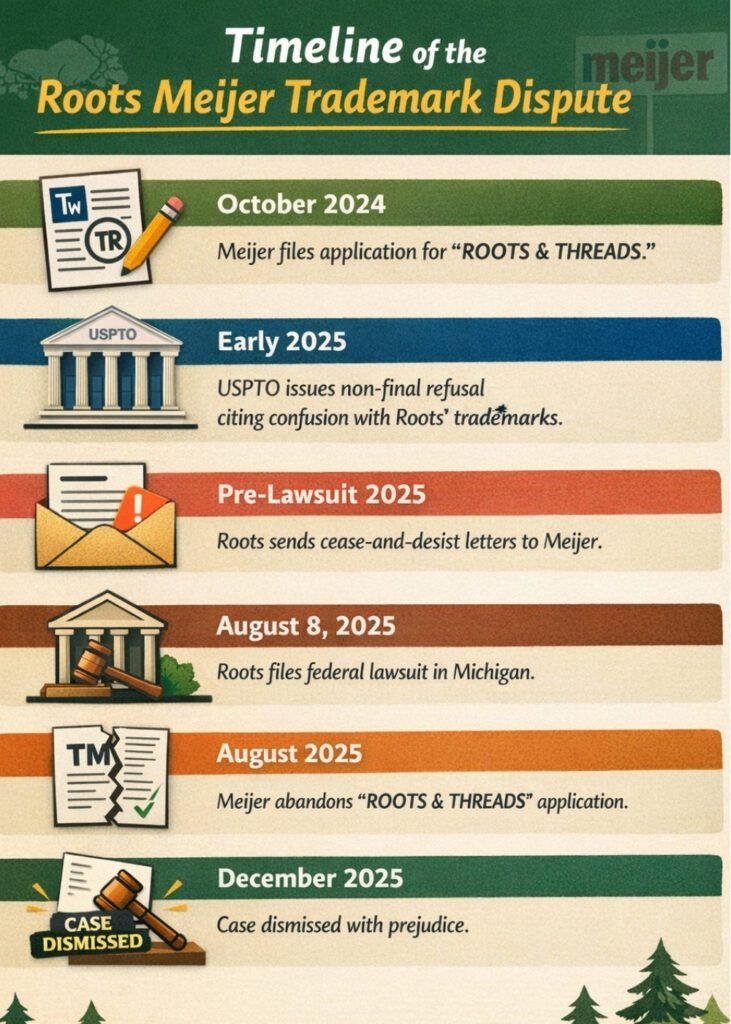
What Led to the Dispute Escalating?
This is where the dispute becomes most interesting; in fact, it almost becomes relatable.
Most disputes of this nature do not go to court. The processes are usually resolved with a name change.
But in this case, we have:
This is a combination most disputes are likely to involve when crossing the legal line.
I have experienced this same scenario with smaller companies where the leaders believe, “It’s probably fine” or “We’ll address it in the future.”
But “the future” is usually when they are dealing with a lawsuit.
What is the Current Status of this Dispute?
At the end, the federal case was dismissed with prejudice in December 2025.
It is important to note that most cases that are dismissed with prejudice rarely have the one side “wins” scenario.
It is usually case of the parties involved reaching:
Moreover, the abandonment of Meijer’s trademark application for ROOTS & THREADS likely indicates that the name of the brand did not move forward.
Legal and Business Impact
This case may appear to be a single case and specific, but the impact has far and wide ramifications.
For Retail Brands
This case illustrates the potency and peril associated with private label branding.
For Entrepreneurs
This is a case that shows the name of a particular branding line is not easy. The name chosen must satisfy legal as well as the creative requirement.
A Google search does not provide the answer; a conscientious trademark search must be done.
For Legal Professionals and Students
This case illustrates and enact the core principles of trademark law. Other legal and brand protection strategy of overlap and confusion, likely to be seen and reinforced are, provide a brand cohesion with this case.
For Marketing Professionals
Brand naming affects:
A name that performs well in marketing but can cause legal issues? That’s a liability, not an asset.
Expert Insight: Why This Case Matters
What do we take away from this case?
The roots Meijer trademark dispute reveals another simple truth that is encouraging to trademark lawyers.
It is easy to understand that trademark law is all about identification.
Once there is confusion about what the intent of the brand is, trademark law is triggered.
The most important is that there is consumer confusion, and the law protects that.
What You Should Learn and Should Not Ignore
Pragmatically speaking, what do we take away from this case?
✔ Conduct a Thorough Trademark Search
It should not be limited to a Google search. You should look at official search databases for registered and unregistered similar marks.
✔ Don’t Use “Close Enough” Names
If it seems similar then it most likely is.
✔ Don’t Ignore Warning Letters
They can be the first step in a potentially damaging process.
✔ Trademark Registration Should be Done As Soon As Possible
This greatly enhances your position at law.
✔ Protect Your Brand
This includes brand monitoring, and your trademark rights.
Frequently Asked Questions
Q. What is the Roots Meijer trademark dispute?
The roots meijer trademark dispute involves Roots Corporation suing Meijer over its “ROOTS & THREADS” children’s clothing line. Roots argued the name was too similar to its brand and could confuse consumers into believing the products were connected, sponsored, or produced by Roots.
Q. Why did Roots sue Meijer?
Roots filed the Meijer lawsuit because it believed Meijer’s branding created a risk of consumer confusion. The company claimed the similar name could mislead customers into thinking the products were affiliated with Roots, potentially harming its reputation and weakening its established brand identity.
Q. What is trademark infringement in simple terms?
Trademark infringement occurs when one business uses a name, logo, or symbol that is confusingly similar to another brand. This similarity can mislead customers about the source of a product, making them believe both brands are connected or come from the same company.
Q. What does “likelihood of confusion” mean in trademark law?
“Likelihood of confusion” refers to whether an average consumer might mistakenly believe two brands are related due to similar names, products, or branding. It is a key legal standard used in trademark infringement cases to determine whether a violation has occurred.
Q. What was the outcome of the Roots Meijer trademark dispute?
The roots meijer trademark dispute ended in December 2025 when the case was dismissed with prejudice. This means the lawsuit was permanently closed, and Meijer also abandoned its “ROOTS & THREADS” trademark application, effectively ending the legal conflict between the two companies.
In Closing
The Roots Meijer trademark dispute is more than a simple trademark story, it is a story that all lawyers can learn from.
It demonstrates how:
One of the things I would like you to remember is:
A brand name is one’s identity, but it is also one’s responsibility.
Consider it an asset and protect it as one.
Additional Resources
Here are some reliable sources to deepen your understanding: