

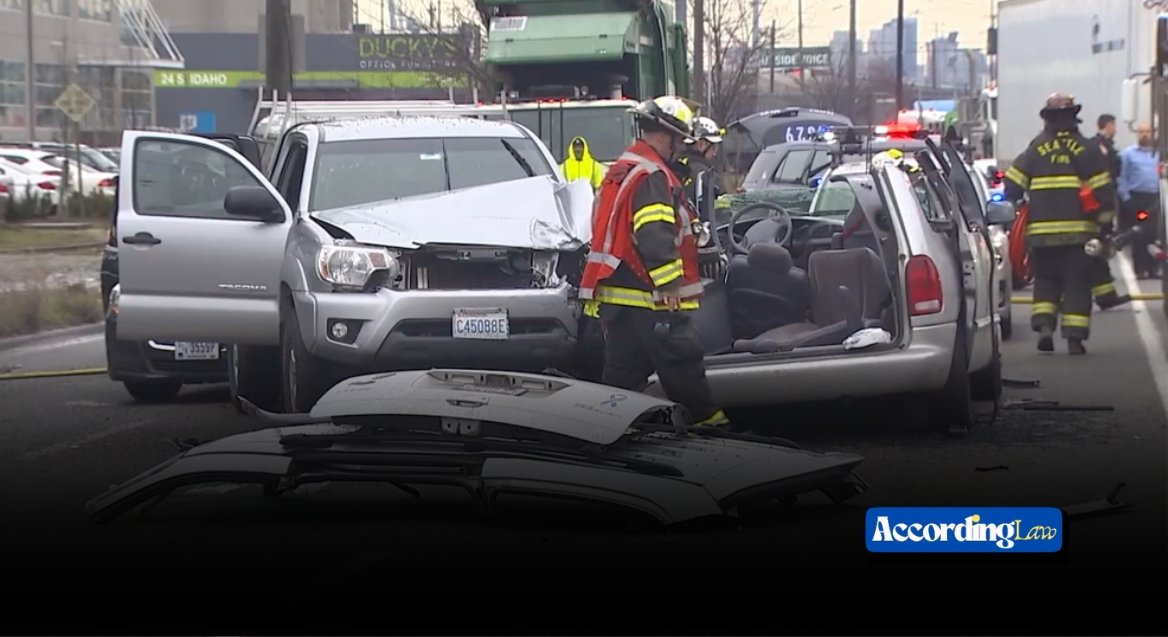
Dealing with the aftermath of a car accident in an urban environment like Seattle requires more than just a cursory understanding of insurance claims. With the city’s complex geography defined by the bottlenecks of I-5, the intricacies of the SR-99 tunnel, and the high-density traffic of the Mercer Corridor, collisions are rarely a simple A hit B scenario.
Instead, car accidents are often multi-vehicle chain reactions where liability is nuanced and contested. For legal professionals and litigants alike, the primary challenge lies in the application of Washington’s Pure Comparative Fault rule.
Table of Contents
Understanding the Pure Comparative Negligence System
Washington State operates under a pure comparative negligence system, codified in RCW 4.22.005. Unlike “modified” comparative negligence states, where a plaintiff is barred from recovery if they are 50% or 51% at fault, Washington allows a claimant to recover damages even if they are 99% responsible for the accident. However, their recovery is lowered by their percentage of fault.
In a technical sense, this means that every action taken by every driver involved in a pile-up on the West Seattle Bridge or in the Rainier Valley is under a microscope. Was the lead driver’s brake light out? Did the second driver follow too closely? Did the third driver fail to notice the sudden deceleration because they were navigating a complex GPS instruction? Each of these factors represents a percentage of the total liability pie.
The Evidentiary Weight of Digital Forensics
In high-stakes litigation, general eyewitness testimony is often the least reliable form of evidence. To combat the verbal nature of multi-vehicle disputes, legal teams are increasingly relying on digital forensics. This involves the extraction of data from Event Data Recorders (EDRs), often referred to as a vehicle’s black box.
An EDR can provide granular data points: the exact speed of the vehicle five seconds before impact, the timing of brake application, and even the steering angle. When this data is overlaid with municipal traffic camera footage and telematics from ride-sharing apps, a reconstructionist can build a high-fidelity model of the crash. This technical approach is vital because a shaft of even 10% in liability can equate to tens of thousands of dollars in a personal injury settlement.
The Complexity of Multi-party Litigation
When three or more vehicles are involved, the legal landscape shifts from a bilateral dispute to a multi-lateral conflict. In these cases, Washington’s rule on joint and several liability become paramount. Generally, defendants are only severely liable, meaning they are only responsible for their own percentage of the damages.
However, if the plaintiff is found to be 0% at fault, the defendants may be held jointly and severally liable, allowing the plaintiff to collect the full judgment from any one of the defendants who has the resources or insurance coverage to pay.
This distinction creates a strategic battleground. Insurance adjusters will fight tooth and nail to assign even 1% of fault to the plaintiff to avoid the joint and several triggers. This is where the technical expertise of a Seattle car accident lawyer becomes indispensable.
By meticulously analyzing the police report for contributing circumstances and ensuring that the plaintiff’s actions are framed within the context of sudden emergency doctrines, counsel can protect the integrity of the claim.
Dealing with Precision Over Generality
Car accident litigation in a pure comparative fault jurisdiction is a game of margins. It is not enough to prove that another driver was negligent; one must proactively minimize one’s own liability through the aggressive use of expert testimony, digital evidence, and statutory interpretation.
General advice fails to account for the specific pressures of Washington law and the technological realities of modern driving. Success in these cases is found in the details, the EDR data, the precise timing of a yellow light and the rigorous application of the law.